Global Economic Outlook 2026: US Market Stability & Investor Challenges

Anúncios
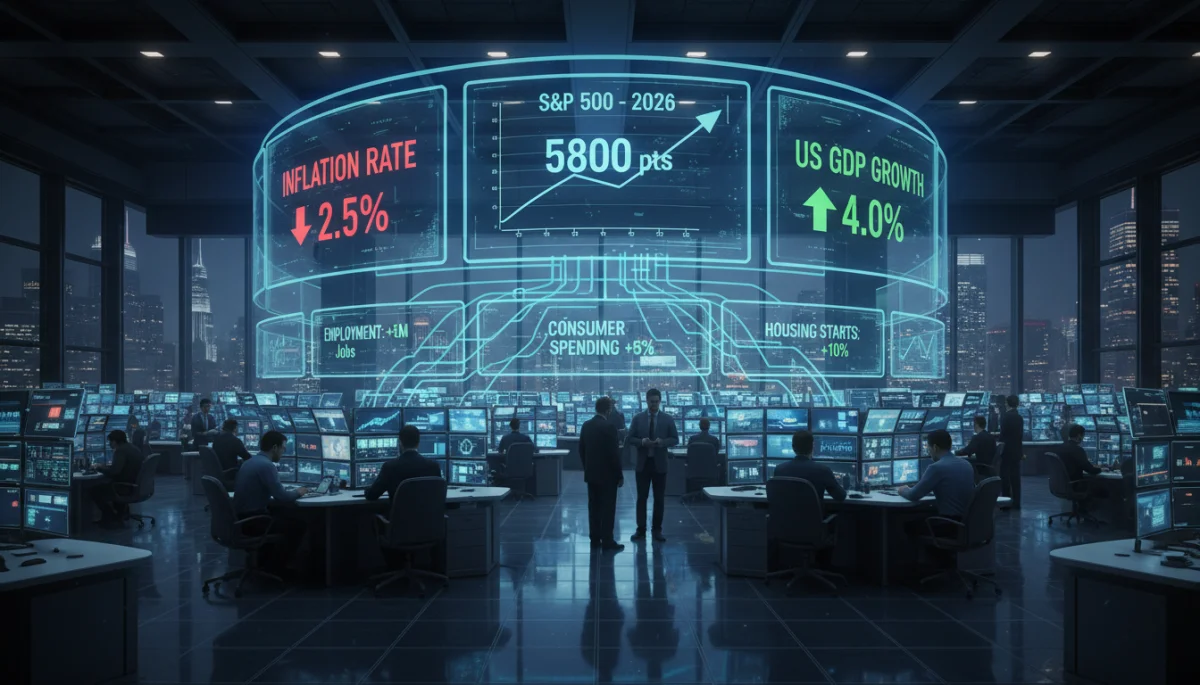
The Global Economic Outlook 2026 projects continued US market stability, balanced by emerging challenges from inflation and geopolitical shifts.
Anúncios
Understanding the Global Economic Outlook for 2026: US Market Stability and Potential Challenges for Investors is crucial for anyone looking to make informed financial decisions in the coming year. As we approach 2026, the global economy presents a complex tapestry of resilience and vulnerability, with the United States market at its core. This article will delve into the key factors shaping this landscape, offering insights into what investors can expect and how to prepare.
Anúncios
The US Economy: A Beacon of Stability Amidst Global Currents
The United States economy has consistently demonstrated remarkable resilience, often acting as a stabilizing force in the global economic arena. Heading into 2026, this trend is largely expected to continue, underpinned by several robust domestic factors. However, it’s not without its nuances, as global developments invariably cast long shadows.
Consumer spending, a cornerstone of US economic strength, is projected to remain solid, driven by a relatively healthy labor market and wage growth. This sustained demand fuels various sectors, from retail to services, contributing significantly to the nation’s GDP. Furthermore, technological innovation continues to be a powerful engine, fostering productivity gains and creating new industries.
Key Drivers of US Economic Resilience
- Strong Labor Market: Continued job creation and declining unemployment rates empower consumers.
- Technological Innovation: Advancements in AI, biotech, and renewable energy drive new economic opportunities.
- Robust Corporate Earnings: Many US companies continue to report strong profits, bolstering investor confidence.
- Monetary Policy Adaptability: The Federal Reserve’s capacity to adjust interest rates provides a buffer against economic shocks.
Despite these strengths, investors must remain vigilant. While the US market may appear stable on the surface, underlying currents such as evolving consumer debt levels and the long-term implications of demographic shifts could introduce volatility. Understanding these dynamics is key to discerning genuine stability from transient calm.
In conclusion, the US economy is poised to maintain its role as a global economic anchor in 2026, supported by strong internal demand and innovation. Yet, its stability is not absolute, requiring careful monitoring of both domestic indicators and international influences.
Inflationary Pressures and Monetary Policy in 2026
Inflation remains a central concern for economists and investors worldwide, and 2026 will be no exception. The trajectory of inflation in the US, and consequently the Federal Reserve’s monetary policy responses, will significantly shape the investment landscape. While recent years have seen efforts to curb rising prices, the path to sustained stability is rarely linear.
Supply chain disruptions, energy price fluctuations, and geopolitical events continue to exert upward pressure on prices. Additionally, a tight labor market can lead to wage-price spirals, complicating the Fed’s efforts to achieve its 2% inflation target. The delicate balancing act between controlling inflation without stifling economic growth will be a defining feature of 2026.
Federal Reserve’s Stance and Market Reaction
The Federal Reserve is expected to maintain a data-dependent approach, carefully monitoring economic indicators before making significant policy shifts. Investors will be keenly watching for signals regarding interest rate adjustments, as these directly impact borrowing costs, corporate profitability, and asset valuations.
- Interest Rate Hikes: Potential for further rate increases if inflation proves persistent, impacting bond yields and equity valuations.
- Quantitative Tightening: Continued reduction of the Fed’s balance sheet, withdrawing liquidity from the financial system.
- Forward Guidance: Clear communication from the Fed will be crucial in managing market expectations and preventing undue volatility.
The market’s reaction to these policies can be swift and sometimes unpredictable. Sectors highly sensitive to interest rates, such as real estate and technology, may experience greater volatility. Conversely, sectors offering stable dividends or defensive characteristics might prove more resilient.
Ultimately, the interplay between inflationary pressures and the Federal Reserve’s monetary policy will be a critical determinant of market conditions in 2026. Investors need to be prepared for scenarios where policy adjustments lead to short-term market corrections, even as the long-term goal remains economic stability.
Geopolitical Shifts and Their Economic Ramifications
The global geopolitical landscape is more interconnected than ever, meaning events in one region can send ripples across the entire world economy. In 2026, ongoing geopolitical tensions, trade disputes, and regional conflicts will continue to pose significant challenges and risks to the otherwise stable US market. Understanding these external factors is paramount for comprehensive risk assessment.
The relationship between major global powers, particularly regarding trade and technology, will be a key area of focus. Any escalation or de-escalation in these dynamics can impact global supply chains, commodity prices, and investor confidence. Furthermore, the stability of critical regions, such as Eastern Europe and parts of Asia, directly affects energy markets and international commerce.
Impact on Global Supply Chains and Trade
Geopolitical events often lead to disruptions in global supply chains, increasing production costs and contributing to inflationary pressures. Businesses that rely heavily on international trade routes or specific raw materials are particularly vulnerable to these shifts. Diversification of supply sources and regionalization strategies are becoming increasingly important for mitigating these risks.
- Trade Policy Uncertainty: Shifting alliances and protectionist policies can create unpredictable trade environments.
- Resource Security: Competition for essential resources, including rare earth minerals and energy, can intensify.
- Cybersecurity Threats: Geopolitical rivalries often manifest in cyber warfare, impacting critical infrastructure and financial systems.
For investors, geopolitical risks translate into potential volatility in specific sectors, such as defense, energy, and technology. Companies with significant international exposure may face higher operational risks and regulatory hurdles. Evaluating a company’s resilience to geopolitical shocks will be a crucial part of due diligence.
In summary, geopolitical shifts introduce an element of unpredictability into the global economic outlook. While the US market may exhibit internal stability, it is not immune to external shocks. Investors must adopt a global perspective, monitoring international relations closely to anticipate potential impacts on their portfolios.
Technological Disruption and Innovation’s Role
Technological disruption is not merely a trend; it’s a constant, accelerating force reshaping industries and economies globally. In 2026, the pace of innovation, particularly in areas like artificial intelligence (AI), biotechnology, and sustainable energy, will continue to play a transformative role in the Global Economic Outlook 2026. For the US market, this means both immense opportunities and significant challenges.
AI, in particular, is poised to revolutionize productivity across various sectors, from healthcare to finance. Its integration into business processes promises to optimize operations, enhance decision-making, and create entirely new services and products. However, this rapid advancement also raises questions about job displacement and the need for workforce reskilling.
Emerging Technologies and Investment Opportunities
Identifying and investing in companies at the forefront of these technological waves can yield substantial returns. However, it also requires a deep understanding of the underlying science, market adoption rates, and competitive landscape. Speculative bubbles in nascent technologies are also a risk that investors must navigate.
- Artificial Intelligence (AI): Investments in AI infrastructure, software, and specialized applications.
- Biotechnology and Healthcare: Innovations in personalized medicine, gene editing, and digital health.
- Renewable Energy: Growth in solar, wind, and battery storage technologies driven by climate initiatives.
- Quantum Computing: Long-term potential for breakthroughs in complex problem-solving and data security.
The challenge for investors lies in distinguishing between genuine innovation with long-term growth potential and overhyped trends. Due diligence, diversification, and a long-term perspective are essential when investing in technologically disruptive sectors.
In conclusion, technological disruption will be a powerful driver of economic change in 2026, offering both unprecedented opportunities and necessitating careful adaptation. The US market, with its robust innovation ecosystem, is well-positioned to capitalize on these advancements, but investors must remain discerning.
US Market Stability: Sectoral Performance and Investment Strategies
Despite the broader narrative of US market stability, a closer look reveals significant variations in performance across different sectors. In 2026, while the overall market may maintain its equilibrium, certain industries will outperform, while others face headwinds. Understanding these sectoral dynamics is crucial for crafting effective investment strategies.
Sectors like technology and healthcare, often seen as growth engines, are likely to continue their expansion, albeit with potential volatility tied to innovation cycles and regulatory changes. Conversely, traditional industries might experience slower growth, necessitating a focus on efficiency and niche markets.
Diversification and Risk Management for Investors
For investors, a diversified portfolio remains the cornerstone of risk management. Spreading investments across various sectors, asset classes, and geographical regions can cushion against downturns in any single area. However, diversification is not merely about holding many different assets; it’s about holding assets that respond differently to market conditions.
- Growth Stocks vs. Value Stocks: Balancing high-growth potential with stable, undervalued companies.
- Equities vs. Fixed Income: Allocating between stocks for capital appreciation and bonds for income and stability.
- Domestic vs. International: Diversifying beyond the US market to capitalize on global growth opportunities.
- Alternative Investments: Exploring options like real estate, private equity, or commodities for portfolio enhancement.
Furthermore, staying informed about macroeconomic trends, corporate earnings, and industry-specific developments is vital. Rebalancing portfolios periodically to align with changing market conditions and personal financial goals is also a key strategy.
Ultimately, while the US market is expected to demonstrate stability, smart investment strategies in 2026 will involve a nuanced understanding of sectoral performance, a commitment to diversification, and a proactive approach to risk management. This will allow investors to capitalize on opportunities while mitigating potential challenges.
Potential Challenges for Investors in 2026
While the Global Economic Outlook 2026 suggests a relatively stable US market, investors must be prepared for a range of potential challenges. These challenges are multifaceted, encompassing economic, political, and social dimensions, and can significantly impact investment returns if not properly addressed. Proactive planning and a realistic assessment of risks are essential.
One primary challenge is the persistent threat of unexpected market volatility. Despite underlying stability, unforeseen events, such as new geopolitical crises, natural disasters, or sudden shifts in consumer confidence, can trigger sharp market corrections. Investors need to have a clear risk tolerance and an emergency fund to weather such storms.
Navigating Market Volatility and Behavioral Biases
Beyond external shocks, investors also face internal challenges, particularly behavioral biases. Emotional reactions to market fluctuations, such as panic selling during downturns or irrational exuberance during upturns, can lead to suboptimal investment decisions. A disciplined, long-term approach is often the best antidote to these biases.
- Inflationary Erosion: The purchasing power of investments can be eroded by persistent inflation.
- Interest Rate Risk: Rising interest rates can devalue existing bonds and increase borrowing costs.
- Regulatory Changes: New government regulations can impact specific industries or investment products.
- Technological Obsolescence: Companies failing to adapt to new technologies may see their market share decline.
- Geopolitical Instability: International conflicts and trade disputes can create market uncertainty.
Another significant challenge is the increasing complexity of financial markets. With a proliferation of new investment products and digital platforms, investors need to be diligent in their research and seek professional advice when necessary. Understanding the fees, risks, and tax implications of different investments is paramount.
In conclusion, while the US market offers a foundation of stability, investors in 2026 will navigate a landscape filled with potential challenges. A combination of careful planning, diversification, emotional discipline, and continuous education will be crucial for achieving long-term financial success.
| Key Economic Aspect | Brief Description for 2026 |
|---|---|
| US Market Stability | Expected to remain strong, driven by consumer spending and tech innovation. |
| Inflationary Pressures | Continued monitoring of supply chains and energy prices; Fed’s policy crucial. |
| Geopolitical Risks | Trade disputes and regional conflicts may impact global supply chains. |
| Technological Disruption | AI, biotech, and green energy offer growth but also pose adaptation challenges. |
Frequently Asked Questions About the 2026 Economic Outlook
The US economic stability in 2026 is primarily driven by robust consumer spending, a strong labor market with consistent wage growth, and continuous technological innovation, especially in AI and biotech, which fuels productivity and new industries.
Inflation in 2026 could erode purchasing power and influence Federal Reserve policies. Investors should monitor interest rate adjustments, as they directly affect borrowing costs, corporate profitability, and asset valuations across various market sectors.
Geopolitical events in 2026, such as trade disputes and regional conflicts, can significantly disrupt global supply chains, influence commodity prices, and impact investor confidence, introducing volatility, especially for internationally exposed companies.
Artificial intelligence (AI), biotechnology, and sustainable energy technologies are expected to be the most influential. These areas promise significant productivity gains and new investment opportunities, but also present challenges related to job displacement and market adaptation.
For 2026, a diversified portfolio across various sectors and asset classes is recommended. Investors should balance growth and value stocks, consider both equities and fixed income, and include international exposure while actively managing risks and staying informed about market changes.
Conclusion
The Global Economic Outlook for 2026: US Market Stability and Potential Challenges for Investors paints a picture of a resilient yet complex landscape. While the US economy is poised to remain a pillar of stability, driven by strong internal demand and technological innovation, it is not immune to the pressures of inflation, geopolitical shifts, and the accelerating pace of technological disruption. Investors must adopt a proactive and informed approach, prioritizing diversification, diligent risk management, and continuous learning to navigate these dynamics successfully. By understanding both the inherent strengths and potential vulnerabilities, investors can strategically position their portfolios to capitalize on opportunities and mitigate risks in the evolving global economic environment.
